AI in insurance: how Tecniseguros is transforming its customer experience. Case study
Tecniseguros transformed claims management with Leobot, improving its customers' experience.

Artificial intelligence is redefining how insurance companies handle customer service, claims and the digital relationship with their policyholders.
Implemented well, it can cut claim processing time by up to 90%, resolve around 70% of repetitive queries without the team stepping in, and run with full 24/7 availability and minimal human involvement in routine processes.
In this article we share a real case of AI in insurance where, at Crata AI, we worked with Tecniseguros to turn request management into an automated, intelligent, scalable and efficient system.
Tecniseguros began a transformation process with Crata AI to modernize its service channels and improve conversational management.
The project started with a very specific goal. It set out to improve the user experience on conversational channels, tidy up the service flows, integrate a new intelligent assistant with Tecniseguros' existing technology and make it easier to handle requests, documents and customer data.
On that base, the solution runs today with advanced AI capabilities in production, from open conversation and sentiment analysis to intelligent request routing and automatic summaries for internal teams. Leobot runs on conversational AI, large language models (LLM), natural language processing, automatic document validation, Python development and API integration with Tecniseguros' systems.
Before getting into the Tecniseguros case, if you want to understand how a business chatbot works under the hood and how to run a measurable pilot, this guide gives you the full picture.
Table of contents
AI in insurance automates key operational processes such as customer service, claims management, document validation and case classification by urgency and type, improving efficiency and cutting response times.
These solutions combine technologies and methods such as:
- Natural language processing (NLP)
- Large language models (LLMs)
- Predictive data analysis and integration with core systems
- Process automation and improvement (Process Intelligence)
Unlike traditional RPA (Robotic Process Automation) solutions, which only replicate mechanical tasks rigidly, modern AI makes it possible to redesign complex processes to maximize efficiency wherever the technology adds real value.
This system replaces cold, static forms with intelligent dialogues that guide the user in a far more natural way. That means an AI assistant does more than answer questions. It can also:
- Interpret the user's intent in natural language
- Validate documents and data in real time against databases
- Open claim files automatically
- Classify the urgency of each case
- Coordinate the internal workflow with the insurer's core systems
The result is a human-in-the-loop operating model, where the technology handles the repetitive tasks and the human team focuses on validating results and on higher-value decisions.
In our experience, this kind of solution isn't about adding technology on top of existing processes. It's about redefining the operation to capture the full potential of AI in insurance.
At Crata AI we apply our own methodology that goes beyond traditional automation. We analyze, redesign and run end-to-end processes with AI, always focused on efficiency, scalability and financial return.
At many insurers and brokers, the customer's first contact during a claim still depends on manual processes. This approach creates several structural problems that get worse as the volume of operations grows.
Channel overload
When a claims peak hits, service teams get a high volume of queries that mixes urgent cases with simple administrative tasks. This can overwhelm the service channels and force the team to prioritize with no clear criteria.
The cost of processing a claim manually can run between 40 and 60 dollars. With effective automation, that cost drops to under 20 dollars per claim (Research and Markets 2025).
Slow information validation
Reviewing documents, photos or policies by hand can significantly delay the opening of a case. Where the first triage is done manually, the time to the first resolving contact can exceed 24 to 48 hours in high-demand periods, a wait no policyholder should face at a critical moment.
Inefficient use of specialist talent
Professionals with technical experience and valuable knowledge end up spending much of their time on transactional tasks such as:
- Requesting basic documentation from the policyholder
- Verifying and logging identity and policy data
- Recording claim information in systems
This limits their capacity to handle the cases that really need experience and expert judgment.
In projects like Tecniseguros with Crata AI, we see it clearly. AI doesn't replace the team, it multiplies it. It removes the low-value operational load, speeds up the processes and lets professionals focus on the decisions where they truly add value.
Context and challenge
Tecniseguros is an insurance broker in Latin America, recognized for its operating volume and its track record in claims management and insurance services.
The company faced a clear operational challenge. It needed to scale its customer service without losing service quality, keeping an agile, user-focused experience, especially at critical moments such as handling requests.
This focus is no accident. At Tecniseguros, user experience and end-to-end customer support are strategic pillars, with a strong focus on building close, clear relationships that add real value at every interaction.
In a context where customers expect immediacy and simplicity, evolving the request-management models becomes key to keep delivering an experience that measures up.
The goal of the project was clear. It set out to redesign the conversational experience from a user-focused perspective, automating key interactions and preparing the architecture for a gradual evolution toward advanced AI capabilities.
That meant more than creating a chatbot. It meant rethinking the contact flows, improving the message format, adapting the conversation to customers' real needs and integrating the channel with Tecniseguros' technology systems.
Project goals
The collaboration with Crata AI has focused on five main pillars.
Optimize the conversational experience. Remap the service flows so the user could move forward in a clearer, guided and more natural way, reducing friction at the key contact moments.
Automate frequent tasks. Let customers make requests and updates from conversational channels, avoiding unnecessary manual processes and improving service availability.
Integrate the assistant with Tecniseguros' technology. Connect the conversational channel with APIs and internal systems for smooth handling of data, users, policies and requests.
Handle documentation more efficiently. Make it easier to handle long documents, multiple files and different formats, preparing the process for increasingly automated validation and reading.
Build a scalable base for advanced AI. Develop the system so it could evolve toward capabilities such as open AI conversation, sentiment analysis, intelligent classification and automatic request routing.
Nota: Los 5 pilares van como subtítulos (H4) en el original. Los dejé como frase con label en negrita; puedes convertirlos en H4 si prefieres mantener la jerarquía.
The solution: the new Leobot virtual assistant
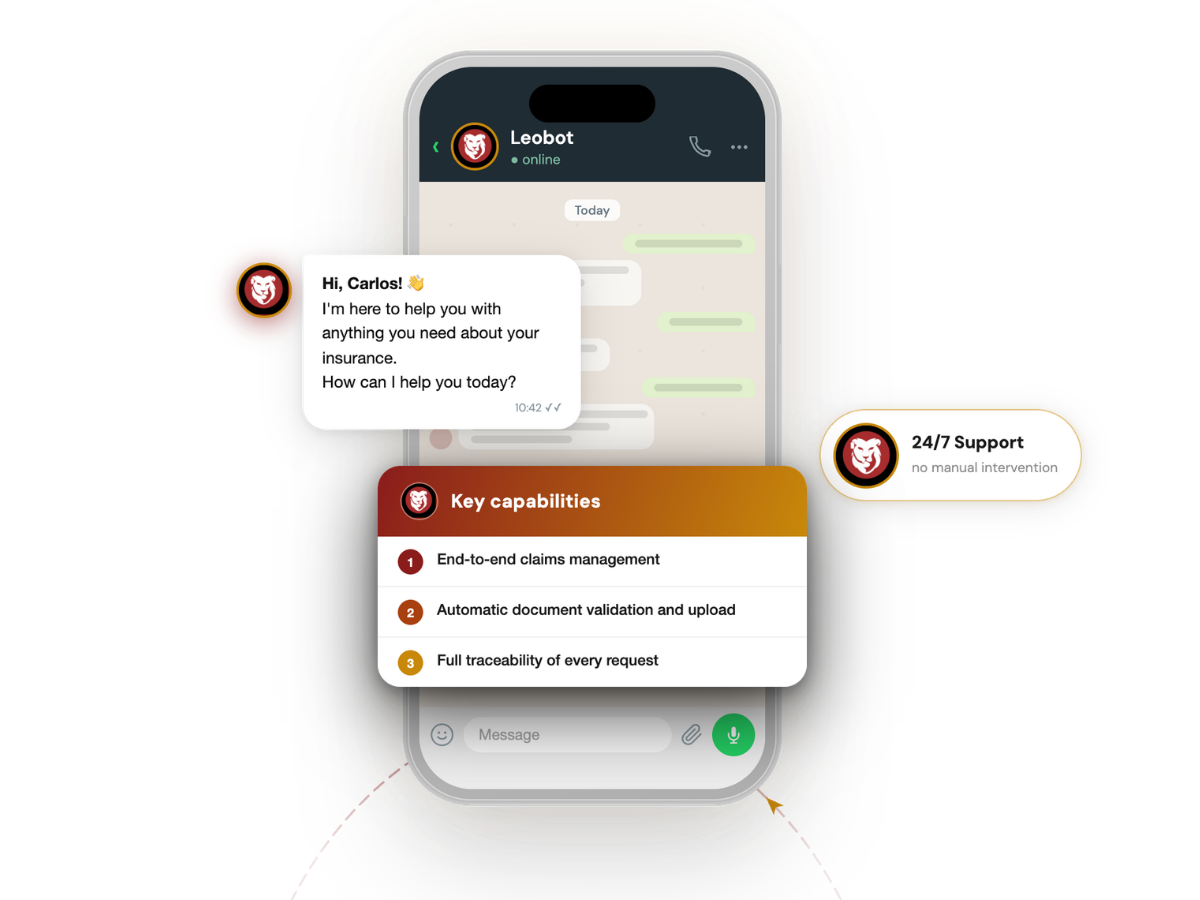
To solve these challenges, at Crata AI we developed Leobot for Tecniseguros, a virtual assistant that combines conversational automation, technology integration and a smoother experience for the customer.
Leobot wasn't born as a simple automated-reply channel. It was built as an automated conversational-management layer integrated with Tecniseguros' operation.
The solution guides the user through structured flows, collects relevant information, automatically updates data tied to their profile and adapts the experience to the relationship between users, contact numbers and policies.
One of the key points of the project was the integration with Tecniseguros' technology. It meant the assistant didn't work as an isolated tool. Instead, it works as an interface connected to the existing systems, able to look up, log and update information smoothly.
On this base, Leobot already includes conversational AI, intent analysis, sentiment analysis and automatic request routing, and Tecniseguros and Crata AI keep expanding its scope
Flow optimization and Smart Routing
The first step was to optimize the existing conversational flows, reviewing the user journey, adjusting messages, reducing ambiguity and adapting each interaction to the customer's real needs.
But the value of the project isn't only in the conversation the user sees. Behind Leobot, a solid technology base was built, integrated with Tecniseguros' ecosystem, able to connect the conversational channel with its internal systems, manage dynamic user and policy information, and run on a structure ready to scale.
This base handles complex scenarios typical of the insurance sector. A single contact number can be linked to several users, each user can hold different policies, and every interaction has to adapt to the right context. Leobot organizes that complexity to give the customer a smoother experience and internal teams a more orderly workflow.
The solution also includes a document-management layer designed to work with multiple files, long documents and different formats. This structures the incoming information better, makes it easier to process and significantly improves document-handling efficiency.
On this architecture, the project is moving toward an AI-managed Smart Routing model, able to interpret open-ended requests, identify what information to ask the user for, analyze the context of the interaction and summarize the key information to make later handling easier.
This evolution combines three layers:
- Optimized conversational flows to improve the customer experience: clear journeys, better-structured messages and less friction for the user.
- Operational integration: connection with Tecniseguros' APIs and systems to manage data, users, policies and profile updates.
- Advanced AI capabilities in development: natural conversation, sentiment analysis, request classification and summary generation for internal teams.
How automated request and claims management works
In practice, Leobot works as a conversational layer integrated with Tecniseguros' operation:
- The user starts the conversation on WhatsApp.
- Leobot guides the interaction through flows designed by request type.
- The assistant collects and structures the information needed to move the case forward.
- When relevant, the solution looks up or updates data tied to the user's profile, their policies or their relationship with Tecniseguros.
- The integration with internal systems lets information flow in a more orderly way between the conversational channel and the operational teams.
On this base, the solution already interprets open-ended requests, classifies cases, analyzes sentiment and summarizes the key information to make later handling easier.
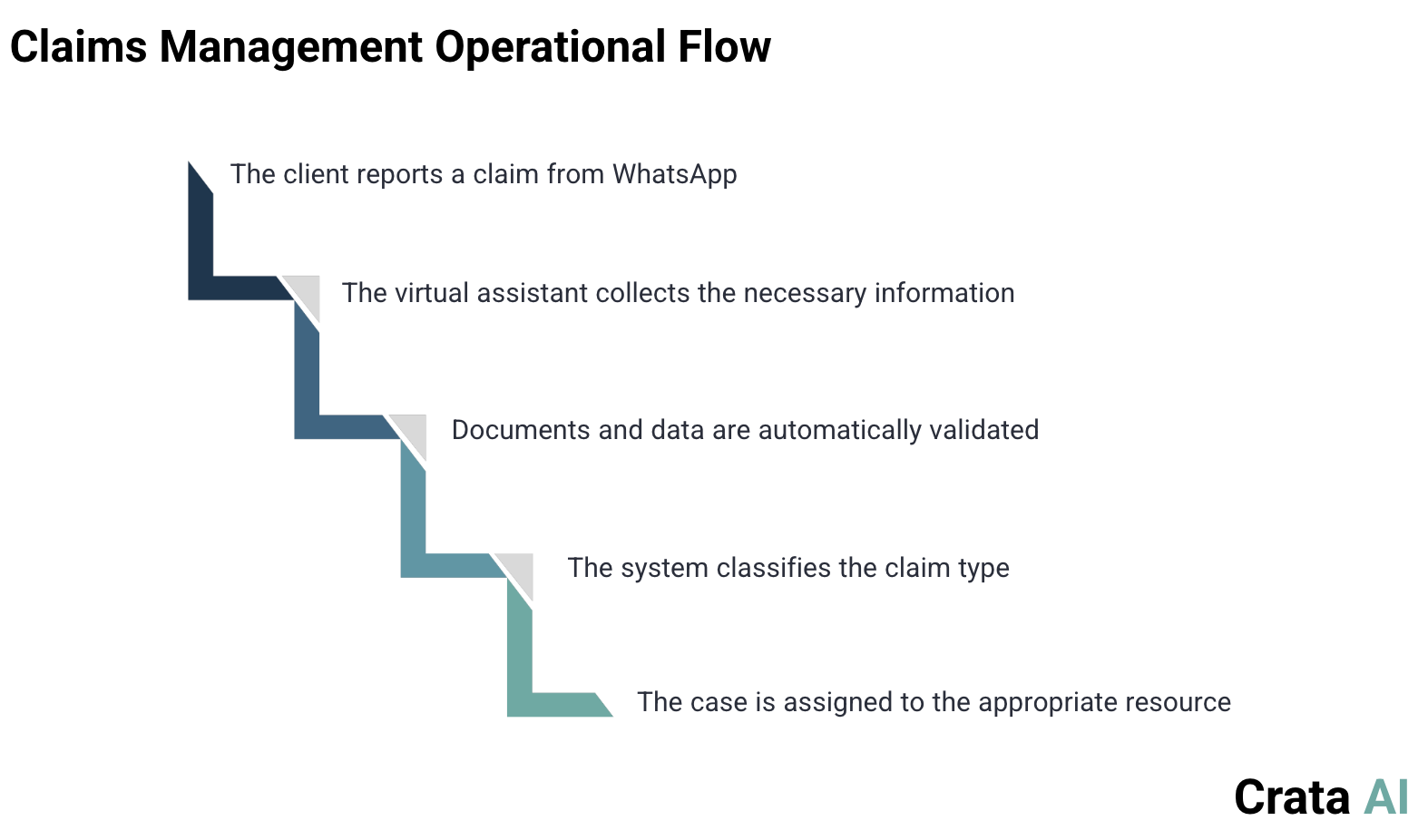
This model reduces operational friction and lets the process start in a matter of seconds.
“Leobot turns technology into a layer of intelligence at the service of the customer. It brings data, documents and processes together so every interaction is simpler for the user and more efficient for the operation.”
The complex claims-management flow, together with the integration with core systems, makes it possible to scale toward more sophisticated models of automation, analysis and decision-making.
At Crata AI and Tecniseguros we are already working to evolve this solution toward an increasingly autonomous, intelligent and business-impact-focused operation, with the integration of advanced AI capabilities.
Automation vs traditional process
The table below sums up the key differences between the traditional manual process and the automated model we are building with the Leobot system:
Key capabilities of the solution and the path toward AI at Tecniseguros
The solution Crata AI developed for Tecniseguros combines conversational automation, technology integration and a clear roadmap toward advanced AI.
- Optimized conversational guidance: supports the user through clearer flows, better-structured messages and an experience adapted to their needs.
- Dynamic management by user and policy: handles scenarios where a single number can be linked to several users or policies, adapting the conversation to the context.
- Integration with internal systems: connects the conversational channel with Tecniseguros' technology to look up, log and update information more smoothly.
- Efficient document handling: makes it easier to work with long documents, multiple files and diverse formats, using advanced document-management, parsing and validation technologies.
- Evolution toward conversational AI: the project is moving toward leading AI capabilities that interpret natural language, analyze intent, detect sentiment and route requests intelligently.
- End-to-end claim management: covers the guided opening of claims, automatic document validation, responses adapted to the claim type, checking the case status and transfer to an agent with full context.
Together, these capabilities turn WhatsApp communication into a more effective, integrated and scalable channel. The solution structures information from the first contact, reduces operational friction and paves the way toward an increasingly autonomous operation, supported by advanced AI capabilities.
Operational results: impact on efficiency
Implementing Leobot has done more than digitize a channel. It has improved Tecniseguros' performance KPIs and enabled a transition toward an intelligent operations model with direct impact across several key areas.
- More than 800 claims handled per month through Leobot
- 90% reduction in claim processing time
- 5x faster for the customer when resolving questions, compared with the previous manual process
- 50% growth in claims handled from mobile
Artificial intelligence does more than optimize customer service. It makes it possible to redefine an insurer's entire operating model.
The market reflects this clearly. According to McKinsey & Company (2025), 70% of insurers are planning to increase their AI investment, and it isn't just a technology trend. It's a direct response to competitive pressure and to the growing expectations of policyholders.
Among the most relevant benefits for companies in the sector:
- Greater operational scalability without a proportional rise in costs
- Administrative cost reductions of up to 50% in claims management (Research and Markets 2025)
- Better customer experience at the most critical moments of the relationship cycle
- Faster claim resolution, cutting the average time to close
- Fraud reduction through real-time predictive analysis during the claim process
Beyond external service, many operations teams complement these solutions with internal knowledge chatbots so their agents can instantly access coverage, procedures and policies, without relying on manual document searches.
The sector is evolving toward increasingly intelligent models. In the coming years, we will see AI used to manage claims and also to:
- Anticipate risks through predictive analysis before claims happen
- Detect fraud with real-time data models during the claim process
- Personalize insurance products based on each customer's real risk profile
- Optimize customer retention with proactive, behavior-based engagement
Market data. The global market for AI in claims processing will grow by USD 1.39 billion between 2024 and 2029, at a CAGR of 28.4% over the period, according to Research and Markets.
AI makes it possible to transform insurance from a reactive model into a proactive one. The companies that lead this transition will be better positioned to retain customers, reduce claims rates and operate more efficiently in an increasingly competitive market.
Power your operation with AI in insurance
If you want to explore how to bring AI into your operation, design custom automations or start with a Crata AI AI Quickstarter, we can help you define the roadmap that best fits your company.
The AI Quickstarter is our structured methodology for moving from intent to execution in a few weeks. We combine business analysis, data assessment and technical validation to identify where AI can create real impact. This isn't theory or generic cases. We work on your processes and your information to spot concrete opportunities, prioritize the use cases with the highest return and validate their feasibility before investing in development.
During the process, we analyze your current operation, identify bottlenecks and repetitive tasks, assess the automation potential and design an initial architecture adapted to your context. The result is a prioritized list of use cases, a clear estimate of impact (time savings, efficiency or revenue gains) and an actionable roadmap to implement AI in a gradual, safe way.
If you want to go beyond exploration and start applying AI with a business focus, this is the starting point.
Book a free call and let’s discuss your case.
Contact: [email protected]
Frequently asked questions about AI in insurance
When should you implement an AI assistant in insurance?
AI in insurance is especially valuable when the volume of manual tasks holds back the resolution of urgent cases, when customer wait times exceed the sector's expectations, or when the operations team spends more than 40% of its time on repetitive administrative tasks. It's the ideal solution for companies looking for immediate scalability on channels like WhatsApp without expanding headcount.
What AI do leading insurance companies use?
Leading insurers implement a combination of conversational AI, natural language processing (NLP) models and, in some cases, computer vision to analyze claim images. These technologies make it possible to understand the customer's natural language, validate documentation and run management flows autonomously. According to Deloitte, 76% of US insurers have already implemented generative AI in one of their operational areas.
What is an insurance chatbot?
It's an intelligent assistant designed to run end-to-end operational processes, from checking policies and coverage dates to fully reporting a claim. Unlike basic bots based on fixed rules, an AI insurance chatbot is trained to understand the user's intent, adapt to the context of the conversation and carry out actions in backend systems, such as opening case files automatically.
What does AI make possible in claims management?
It makes it possible to move from manual, fragmented processes toward more agile, integrated models assisted by AI. In a first phase, that includes optimized conversational flows, integration with internal systems and better data and document handling. In more advanced phases, AI can interpret open-ended requests, classify cases, analyze sentiment, summarize information and support routing to the right team.
What role do chatbots play in the insurance sector?
Their main role is to act as an executive filter that autonomously handles much of the repetitive queries and tasks. In the Tecniseguros case, around 70% of repetitive queries are resolved without the team stepping in. By taking on all the initial administrative load, data collection, identity validation and case opening, they let human agents focus solely on the complex cases that need empathy and expert judgment.
McKinsey & Company (2025). The future of AI in the insurance industry
Research and Markets (2025). AI in Insurance Claims Processing Global Market Report 2025
Master of Code (2026). Insurance AI Chatbots: 20 Use Cases and Examples (ROI benchmarks)
Research and Markets (2025). AI in Insurance Claims Processing Market
Deloitte Insights (2025). Scaling gen AI in insurance